
This advanced gameplay guide covers what Neverness to Everness opens up past the tutorial - the combat mechanics that reward mastery, the traversal systems that define movement, and the operator systems that build in depth over time.
The version of NTE you find at hour twenty is not the same game you left behind at hour three. The city keeps giving, and so does the combat.
See what the game becomes once it opens up
Explore the gameHow advanced combat works
The six-attribute system is the mechanical foundation of NTE, and understanding it deeply is what separates players who find the mid-game easy from those who find it frustrting. Each attribute counters one other in a fixed sequence. Building around the counter chain means building teams where at least one operator exploits each enemy type you are likely to encounter.
Past the tutorial, the game introduces attribute-locked enemies - opponents whose defensive rating against non-counter attributes is significantly higher. Against these enemies, a team without a counter operator does not just struggle - it deals a fraction of its normal output. The game never announces this clearly, which is why so many players hit a wall in the second and third districts.
The skill that separates good play from great play is off-field management. When an operator is on the bench, their passive skills continue to accumulate. Operators with powerful passive windows should be rotated in, abilities used, and rotated back out strategically rather than being held in reserve for emergencies.
Traversal mastery in Hetero City
Wall-running in NTE has a momentum decay system that most players never fully explore. Speed builds as long as wall contact is maintained and a surface angle is within a tight threshold. Breaking contact too early - even briefly - resets the speed accumulation. Players who learn to extend wall contact through curved architecture will reach speeds that feel qualitatively different from early traversal.
Vehicle traversal has a parallel depth. The driving physics in NTE reward smooth deceleration and apex approach rather than full-throttle navigation. Players who master vehicle cornering will find the street-level city substantially faster to navigate. Driving and wall-running can be chained - exiting a vehicle with forward momentum and immediately entering a wall-run transfers speed efficiently.
Ready to see the city from the top?
See the worldThe operator system past the surface
Each operator in NTE has three layers of content: their combat role, their passive skill set, and their personal story content unlocked through the relationship system. Most players engage fully with the first layer, partially with the second, and minimally with the third - but the third layer is where the writing quality of the game shows most clearly.
| Operator layer | What it provides | When it matters |
|---|---|---|
| Combat role | Active abilities, attribute alignment, team slot function | Every combat encounter |
| Passive skills | Off-field buffs, activation conditions, cooldown interactions | Mid-to-high-level content |
| Personal story | Relationship dialogue, backstory episodes, cosmetic rewards | Optional, any point |
-
Map your team's attribute coverage Before the third district, chart which attributes your current three operators cover and identify gaps against common enemy types
-
Audit your off-field rotations Review which operators have strong passive skills and build a rotation habit around their activation windows rather than just their cooldowns
-
Learn one wall-run chain per district Each district has a signature traversal sequence that rewards learning - master one per area before moving on
-
Save operator story unlocks Personal story episodes can be accessed at any time - play them after major story beats for context rather than immediately on unlock
-
Check the event roster before spending Limited events often provide premium currency - clear the available event content before spending saved pulls on standard banners
Content that opens over time
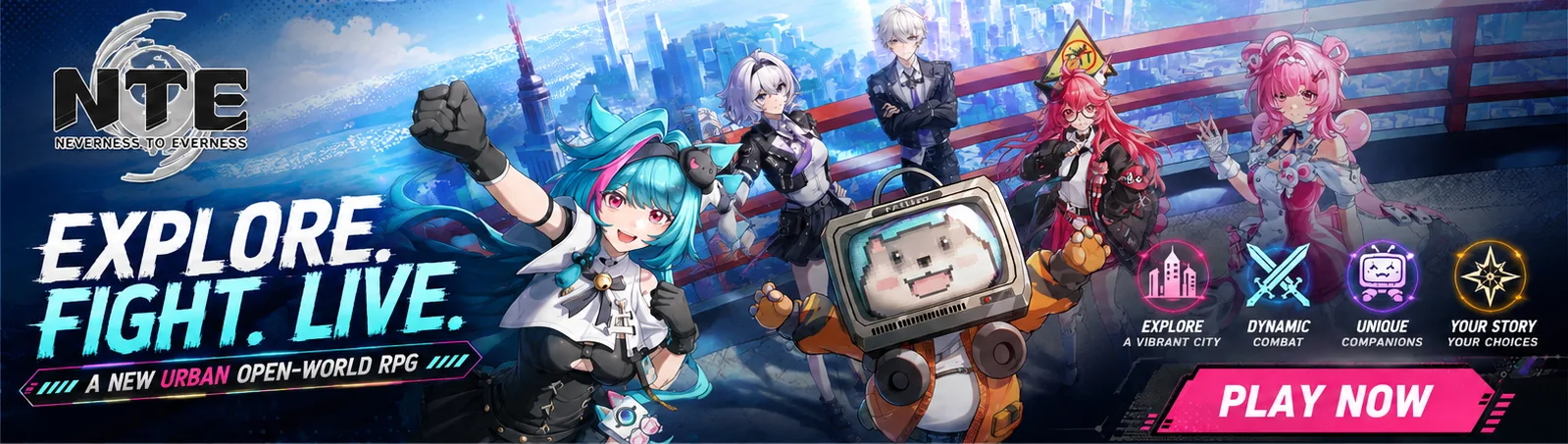
Hetero City is not a static map. Hotta Studio has designed the post-launch content pipeline around new city districts, faction-specific content, and collaborative events. [CITE: Source: WccfTech, Neverness to Everness expansion plans interview, 2026]
The faction system, which becomes visible from around the fourth district onward, introduces competing urban organisations with their own operators and story content. Aligning with factions is not a binary choice - players can maintain relationships with multiple factions simultaneously, though certain questlines require prioritisation.
Six-attribute combat
- Deep countering system that rewards composition knowledge
- Takes significant time to master fully
Traversal mastery
- Speed-transfer mechanics that reward precision movement
- Momentum decay punishes early learning attempts
Operator depth
- Three content layers per character with genuine writing quality
- Personal story layer is invisible until deliberately sought
Faction system
- Branching organisation relationships with unique content
- Faction priorities create light commitment tension
Post-launch content
- Expanding city map with new districts and events
- Release cadence requires patience between major updates
- Check every operator's passive skills before building a team rotation
- Practice wall-run chaining through curved architecture in each new district
- Build at least one team specifically around attribute countering before any boss encounter
- Complete faction introduction missions before committing to a primary alignment
- Review the event calendar each week before deciding where to spend premium currency
- Six-attribute countering logic has real depth that rewards learning over spending
- Traversal mastery creates a qualitatively different movement experience over time
- Post-launch expansion confirms city map growth across new districts and content
- Faction system adds a narrative layer to exploration that builds across the mid-game
- Off-field passive management is not explained - players must discover it through experimentation
- Faction commitment decisions create some content tension for players wanting full coverage
NTE's advanced systems reward players who engage with them intentionally - the combat depth, traversal mastery, and operator story content form a game that becomes richer the more time is invested in understanding how its mechanics interact
Who finds this game most rewarding
NTE rewards players who enjoy uncovering how a system works rather than having it explained - the depth is there, but finding it requires curiosity and a willingness to experiment with team composition and traversal technique
If you are the kind of player who finds satisfaction in mastering movement and team mechanics rather than outspending content, Hetero City offers that in ways that remain interesting well past the first dozen hours
What is the hardest part of advanced combat?
Does traversal mastery matter for combat?
Can I experience all faction content in one playthrough?
Is post-launch content free?
Ready to see what the city holds once it fully opens?
Start your journey


The off-field passive point is exactly right. Took me fifteen hours to realise my best operator had a passive that I was completely wasting because I never rotated them off the field. The game doesn't explane this well.